Showing posts with label david jacobs. Show all posts

Wednesday, 21 September 2016

Chapter 16 - A nailed on defence

So, let us summarise. If we follow through from Stephen Ward we can see that he was, most likely, an MI5 operative with ties to the intelligence agency boss, Roger Hollis, and who, if not an actual Monarch mind-controller, was extremely gifted at persuading women to work on his behalf. Think back to Chrissie’s claim that Ward had full control of her mind.


In addition he was connected to an international sex ring that controlled a wealth of dynamite blackmail material. Ward’s blackmail portfolio was passed on to the flamboyant celebrity lawyer, David Jacobs.  

Jacobs was well known on the London legal scene and would often attend court wearing full make-up. He had a stellar clientele including Sir Laurence Olivier, Shirley Bassey, Marlene Dietrich, Diana Dors, Judy Garland and the Rolling Stones. He had represented Liberace in his successful libel case against the Daily Mirror who famously accused Liberace of being “this deadly, winking, sniggering, snuggling, chromium-plated, scent-impregnated, luminous, quivering, giggling, fruit-flavoured, mincing, ice-covered head of mother love.”

Possibly of further significance, or equally just pure coincidence, is the fact that the actor Laurence Harvey – the original star of the mind-control movie Manchurian Candidate – was another client of Jacobs.

As were the parents of an actual Manchurian candidate: Ruth Ellis. Just why would the impoverished parents of a convicted murderer need to employ the services of the celebrity lawyer whose other clients included John Vassall, Diana Dors and Stephen Ward unless they were all bound together inextricably by shared secrets?

But perhaps Jacobs’s most famous client was Brian Epstein and the Beatles. Indeed, Jacobs’s Hove residence was the, not so glamorous, location for Ringo Starr’s honeymoon following his first wedding in 1965.

Jacobs place in the pantheon of Beatle fame, however, is preserved because of his role in the disastrous Seltaeb (Beatles backwards) deal through which Epstein and Jacobs somehow connived to give away the Beatles’ merchandising rights for next to nothing.

The lucky recipient of this enormous cash-cow was a Kings Road dandy by the name of Nicky Byrne who found himself in the fortuitous position of acquiring a deal giving him a 90/10 split, in his favour, of the royalty proceeds. Now this was a truly monumental faux-pas as unscrupulous manufacturers had quickly discovered that you could sell absolutely anything that was Beatle branded: For Byrne it was a literal licence to print money.

History, however, has been, surprisingly, generous to Epstein and Jacobs over this matter, sighting that they could not possibly have foreseen just how lucrative this fledgling merchandise business would become. Nevertheless, it troubles me slightly that the beneficiary of this massive windfall should be an already wealthy young member of the burgeoning Chelsea set.

Not just any old member of the Chelsea set either but a motor-racing-driver who had been previously in the employ of Peter Rachman in one of his nightclub ventures!


The book (Shout: The Beatles in their generation by Philip Norman) names the club in question as being the Condor Club but it was, in fact, the El Condor Club and, as just mentioned, it was owned, at the time, by Peter Rachman.


Jacobs died in 1968; dangling from a length of silk-cord tied to a beam in his garage, elegant even in death; seemingly yet another suicide victim. Numerous theories abound as to why, or indeed if, he committed suicide, but perhaps the most telling aside came from the actress Suzanna Leigh who, moments after hearing of Jacobs death, received an invitation to lunch in the post from the lawyer. Clearly if he did top himself it wasn’t a hugely premeditated event.


Rumours also abound that our old friends the Kray twins offed Jacobs for declining their tempting offer for him to mount their defence against, subsequently proven, murder charges. I know not if these rumours are true, however, perhaps another interesting defence case he took shortly before his ‘suicide’ is worth resurrecting?

An article appeared in the Daily Mail on Saturday, August 3rd, 1968 concerning one Joseph de Havilland, a Hungarian painter and decorator, who had been discovered on Hampstead Heath crucified on a cross.

My interest was sparked by the tantalising headline ‘Man on a cross ‘black magic’’ but further investigation reveals some other intriguing nuggets and curios.

Firstly, why would our ‘celebrity lawyer’ bother taking a somewhat low-brow and trite case as this?

Well it appears our man Jacobs was himself interrogated by police on this very matter; quite on what grounds is unclear, however, the plod clearly thought of Jacobs as being someone of interest and this, apparently, was enough to pique his professional interest.
Secondly, the men Jacobs had been defending were barred, by law, from using as their defence the fact that de Havilland had asked to be nailed to the cross.

Under British law, a victim cannot consent to be injured: unless the activity which causes the injury might be considered ‘socially useful’.

What counts as ‘socially useful’ in the eyes of the law (e.g. boxing) and what doesn’t (e.g. consensual homosexual sadomasochism) remains a hotly contested issue?

Bizarre, and extreme, as that is the case for the prosecution makes for illuminating reading.


Isn’t that interesting? A man in a ‘semi-trance’ with six-inch nails hammered into his bloodless hands has done so in order that photographs of his ordeal could be taken and sold for a profit.

Interesting also that the man charged with defending the assailants should be a man who has been assigned legal responsibility for a large portfolio of sexual blackmail material and who implies, in court, that the crucifixion was part of some, unspecified, ‘black magic’.

So, what to make of this ‘defence’? We do not know what de Havilland’s motives for being crucified were; however, he seems to have been taking part in some sort of occult ritual. As a defence,  playing the black magic card seems a high-risk strategy; certainly not one designed to endear you to either judge or jury.

It appears that Mr Jacobs, legally denied the opportunity to tell the truth, has concocted the black magic tale to either divert attention away from the intention to photograph and make money from this scheme, or to obscure the sadomasochistic, homosexual aspect of the case.

The latter supposition certainly seems the more likely, particularly in light of the following.

The website from which I gleaned a lot of this information contends that shortly after Jacobs death he left ‘behind almost indecipherable notes. Notes which led to police questioning of several gentlemen, including well-known public figures, about parties which had taken place at country estates and flats across England.
Information about the precise nature of these parties has never been made publicly available.’

Just like a lot of the Ward/Profumo documents which are currently unavailable to public scrutiny until 2046. Just like the Jack the Stripper files which are to remain under lock and key until 2050. Just like the Michael X files which will remain secret until 2054.

However, we can safely deduce that the country estate mentioned is most likely Cliveden, home of the Astor family and the birthplace of the Profumo scandal, whilst we know that Peter Rachman specialised in leasing flats to prostitutes and parties took place at locations as diverse as Lord Boothby’s home, DJ Alan ‘Fluff’ Freeman’s flat and at the now infamous Dolphin Square.

So, could his death actually be connected with materials he had in his possession that he had accumulated over his career?

This article claims that some of the material – sketches by Stephen Ward – landed up in the hands of one of Jacobs’s clerks. Rather than dispose of these, as instructed, it appears the clerk took them to an art dealer. Curiously, the article also talks of a nightclub called the Paint Box which offered its clientele the opportunity to sit and ogle a nude – you could draw them too, apparently – that was run by a lady called Adele de Havilland.

Ward sketch of Adele de Havilland
Could she have been a relation of our fan of crucifixion Joseph de Havilland? Well, whilst it is, of course possible, I doubt that this coincidence will ever fly.
Pathe has a wonderful video of the Paint Box.

However, this site claims the Paint Box had been taken over by Diana Dors; a client of David Jacobs and a willing participant in the orgies organised by her then husband, Dennis Hamilton, which were attended by Stephen Ward and Peter Rachman and that pioneered the use of two-way mirrors to record the bedroom gymnastics of the party’s participants.

The Paint Box video suggests that the club was, in fact, run by Tommy Yeardye, who was a former boyfriend of Diana Dors. Given that the real purpose of the Paint Box was to bypass the laws around nude floorshows – in much the same manner as the owners of Murray’s Cabaret Club utilised – it could well be that this was a front venue for Ward to recruit potential mind-control victims.

Dors and Yeardye
Yeardye’s daughter, Tamara, who now runs the Jimmy Choo shoe enterprise, married into the powerful Mellon family which has, it seems, connections to the CIA LSD operations and to whom David Bruce, the US Ambassador to the UK at the time of the Profumo crisis, had married into. Yet more circles within circles.

With David Jacobs dead the ultimate question remains, where did Ward’s ‘evidence’ go?

Ward was connected to Dr Richard Asher who, and I have first-hand experience of this, was involved in conducting experiments on using LSD for sexual and mental conditioning on patients being supplied to him by Ward. In 1956 Asher had written an article for the British Medical Journal entitled Respectable Hypnosis extolling the virtues of hypnosis in medicine.

Asher worked in partnership with Dr Emanuel Miller who has links to Tavistock as a former leader of the Tavistock Children’s Department. Miller had previously, in 1927, opened the East London Child Guidance Clinic. I wonder now if he was involved in conditioning these children.

The third partner was Sir Raphael Cilento, a man with seeming fascist tendencies and more than a passing interest in eugenics; something which always raises alarm bells.

Eugenics is a belief in the ability to improve the genetic quality of human beings, something the Nazi’s bought heavily into, and one wonders how it was that all of the above had children that had highly successful careers in show-business. Was it coincidence, opportunity, breeding or a payoff for services rendered?

Likewise, is it pure coincidence that Richard Asher, Stephen Ward and Anthony Blunt all had fathers who were Anglican ministers? Roger Hollis, the former Director General of MI5, was the son of a Bishop. Despite this ecclesiastical upbringing Hollis was apparently denied a Christian burial and whose remains, as stated here, are actually hidden behind the wall of a church. This unmarked resting place, it is claimed, denotes the invisible mark of a traitor’s burial. Founder of the Process Church, Robert de Grimston, also came from a long line of clergymen, although his father was a humble shipping clerk. Fathers who are religious leaders are common amongst children who are mind-control victims.

As previously mentioned de Grimston was of Plantagenet stock; as are Richard Asher’s offspring thanks to their mother’s lineage.

All of which means we are now moving into the direction of what I believe this is all about, none of which I can prove of course; speculation city from here on in folks, but if you’ve stayed with me this far then hopefully you will continue to indulge me.

My own theory here is that all this was part of a possible coup for the Crown of England.

The Stuarts are the obvious choice; they are the ones who lost the Crown to the current Royals and they claim to have an Arthurian ancestry. I have a reason to say this; via ‘a reliable source’ I’ve learned there have been four possible attempts to take the Crown in the last hundred years, one was foiled by WWII and the same person involved tried again after the war. Did Stephen Ward stumble upon this?

That would have got him killed, pronto. But as ‘they’ couldn't know who else was involved or what they knew they did it in that very public and messy way to let those people know to shut up, or die.

Yes, I think Ward got too close.

Is it ironic accident, or by pure design, that the Stuarts will regain a grasp on the monarchy when Prince William becomes King? Whatever; back in the sixties that particular piece of monarchical genetic programming had yet to be engineered and the search was far cruder.

Search for what I hear you cry. For the ledgers of course! Don’t worry, all will be revealed I promise. 

Chapter 22 - Baker Street Robbery

On September 11, 1971, exactly forty years before the destruction of the twin-towers of the World Trade Centre an attempt was made, via somewhat unorthodox means, to avert a similarly cataclysmic event from taking place in the United Kingdom.

At least that is what the makers of the 2008 movie, The Bank Job, would have you believe.

It was on this date that Robert Rowlands of Wimpole Street – the same Wimpole Street that housed both Dr Asher and Stephen Ward at various times – tuned into an on-going robbery via his ham radio set. He, according to the accepted story, informed the police of the robbery, who did not believe him, and so he began to record the villains’ conversations until this action finally got their attention. Bizarrely though, despite finally convincing them that a crime was in progress and that it must be happening within a mile and a half of his house – that being the maximum range of a walkie-talkie in those days – the police insisted on searching a total of 750 banks within a ten mile radius. 

The old ham – Robert Rowlands
Remarkably, or perhaps as the result of their tick-box approach, they did manage to visit the bank that was in the process of being robbed. Sadly, and unbeknownst to them, as the robbers had tunnelled their way directly into the vault from underground, the dozy coppers, having found the vault door locked, failed to notice anything unusual and left allowing the robbers to continue their merry rampage through the security boxes undisturbed for the rest of the weekend.

Eventually, the Old Bill reasoned, a distraught bank manager would open up his vault on the Monday morning and find it somewhat emptier than when he locked it up on the Friday evening. At this point he would call them and the investigation could begin. The fact that the robbers, and their ill-gotten gains, would be long gone by this point seemed insignificant.

The makers of the movie insist that the heist was actually an MI5 staged operation to obtain mucky pictures of the Queen’s sister, Princess Margaret, which had been put, for supposed safe keeping, into a security box at the bank. This information, they insist, came from a guy called George McIndoe, who claims to have been an insider and was a producer on the movie.

I shall now quote directly from the linked article above:

“Obviously, we’ve changed the names,” says Clement, “and large parts of our story are invented - they have to be, because no one knows the exact details. All we could rely on what was George McIndoe told us.” And what George McIndoe told them - whether truth or fiction - is quite remarkable. He claimed that “Terry” and his walkie-talkie gang, as they became known, had found sexually compromising photographs of Princess Margaret inside one of the deposit boxes.
“The idea of the photographs was based on a direct conversation I had with George,” explains Clement. “He told me the story, but obviously I can’t prove that it’s true.” Indeed, the real ham radio operator, Robert Rowlands, has spoken out against the film’s insinuation. “The film is an amusing series of misconceptions, dragging in royalty,” he says. “I am in touch with the princess’s solicitors.”
In the film, these photographs are placed in the possession of a shady, real-life character called Michael X, a slum landlord and pimp who tried to present himself as a British version of the activist Malcolm X. His ownership of the pictures bestowed upon him a “get out of jail free card”, whereby the courts overlooked his criminal activity.
After in-depth discussions with McIndoe, Clement and Le Frenais suggested in their story that the robbery was masterminded by MI5, which was eager to get its hands on the photos and thereby neutralise Michael X’s threat.

All of which tends to get my spidey-senses twitching. Clearly if pictures of Princess pisshead being spit-roasted by a couple of black men or, alternatively, of balancing half-pint mugs on John Bindon’s cock, or even details of an alleged lesbian dalliance with the American Sharman Douglas were to come into the public domain then the mother of all scandals would be unleashed, however, they haven’t, so quite why Robert Rowlands felt the need to get the legal profession involved is unclear.

Indeed, why would Rowlands feel the need to get involved at all? My gut instinct is that his involvement and his ‘accidental’ discovery of the walkie-talkie chatter are all a little too convenient.

Rowlands lived at 45 Wimpole Street, half a mile from the bank.
Route from Rowlands’ abode to the Lloyd’s Bank branch

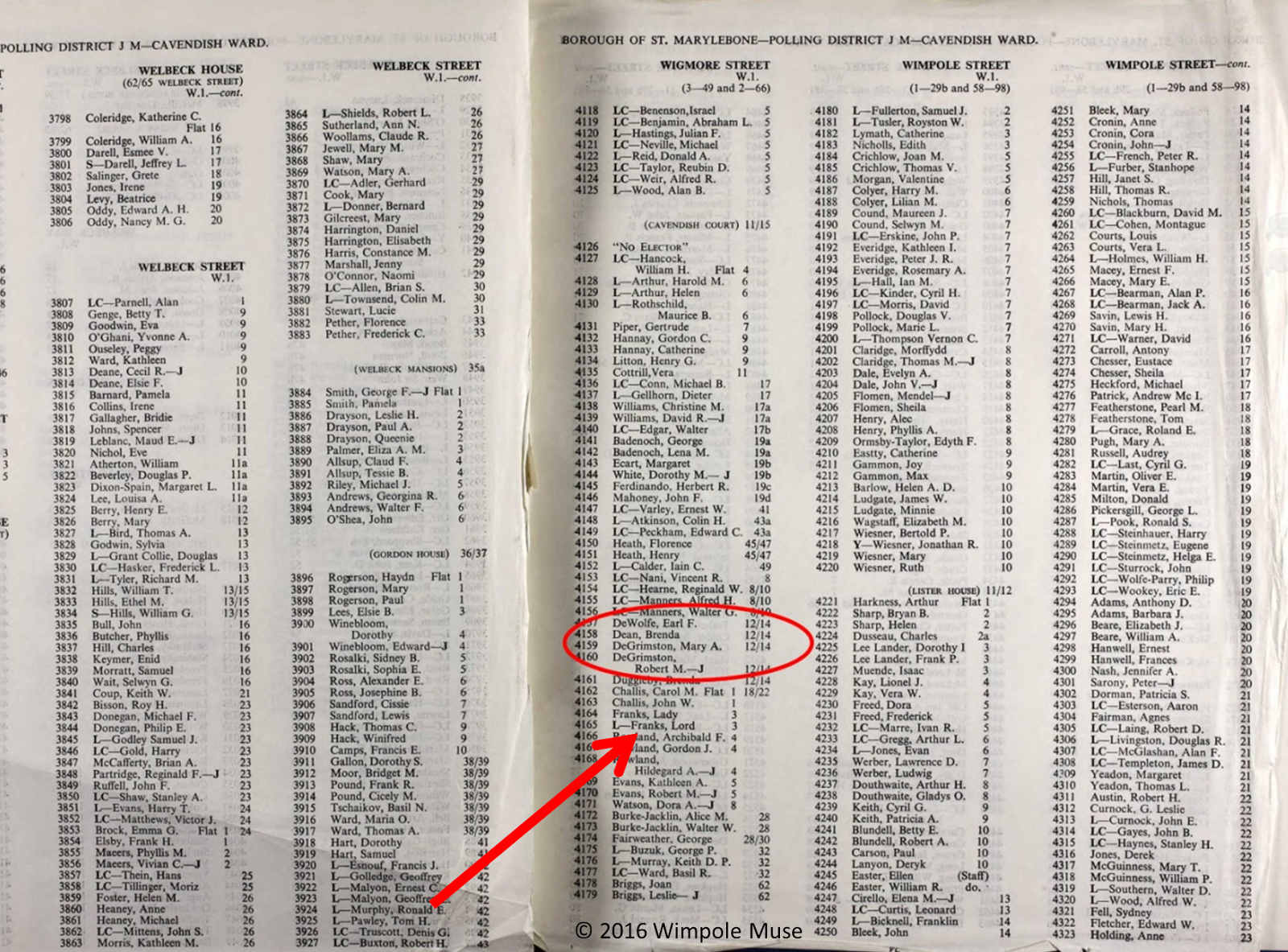
However, just down the road from Mr Rowlands, at Flat 3, 18-22 Wigmore Street – right next door in fact to Felix de Wolfe and Robert de Grimston in 1964 – lived Lord and Lady Franks.


 Lord Oliver Franks is an interesting character in the sense that not only was he a member of the steering committee of the Bilderberg Group, the Rhodes Trust and the Rockefeller Foundation (which, lest we forget, funded the Tavistock Institute) but he was also a former chairman of Lloyds Bank. Indeed he was still a director of the bank at the time of the robbery. Franks, as well as being yet another son of a clergyman, is also noted for the dubious distinction of having had on his staff at various times Kim Philby, Guy Burgess and Donald Maclean, three of the notorious Cambridge Five ring of spies.

Lord Oliver Franks
So, we have a key proponent of one-world-government, an architect of the North Atlantic Treaty, a former British ambassador to the US and a director of Lloyds Bank living just a mile away from a branch of the Bank that is being robbed to order by MI5.

Does this not strike you as being somewhat odd?

Not only this but Lord Franks was an associate of David Bruce (of whom we have already spoken), the JFK appointed US ambassador to Britain and former OSS man who had been mentored by W. Averell Harriman, a man who had also been an ambassador to Britain, as well as to the Soviet Union, and who, just happened, to be a patient of Stephen Ward.

David Bruce was also known to discuss varied and numerous propaganda strategies with Nancy Astor, the key player behind the right-wing Cliveden Set.

Bruce was a former intelligence agent and was a friend of the James Bond author Ian Fleming. Fleming, who based the Bond character on his experiences whilst working for MI5, was another former naval intelligence man who had worked with Roger Hollis, Guy Burgess and Donald Maclean at the agency.

Hollis has long been suspected by authors such as Chapman Pincher of having been a Russian spy and, it has been claimed, it was Hollis who was responsible for instructing Guy Burgess to warn his friend Donald Maclean to defect to Russia when Maclean’s cover had been blown.

In order to make this urgent warning Burgess had to first contrive a situation in order that he could return home to England from the United States where he was then employed at the UK embassy in Washington DC. To this end he committed a series of very deliberate, and deliberately embarrassing, motoring offences which duly ‘convinced’ his boss that Burgess had to be sent back to the UK.

So, just who was Burgess’s boss at the time? None other than Oliver Franks!

The main allegations accusing Hollis of being a Soviet agent came from Chapman Pincher’s 1981 book Their Trade is Treachery, published many years after Hollis’s death in 1973. 

The inside information for this book came from the disgruntled former MI5 officer, Peter Wright, who would later publish his own expose, Spycatcher. The man who would pair the two together for this MI5 expose was the, somewhat surprising middle-man, and former MI5 staffer, Lord (Victor) Rothschild. Rothschild, you will recall, was another Cambridge Apostle and friend of the Russian ‘spies’ Burgess, Maclean, Philby and Blunt. Indeed, Rothschild was widely suspected as being the infamous ‘Fifth Man’ in the Cambridge spy circle.

Despite the devastatingly embarrassing nature of Pincher’s revelations to both the government and MI5, the fact that neither organisation sought to stop the book’s publication – indeed a simple phone call to the publisher Lord Forte would have achieved this result – seem to imply that the British Government much preferred to sully the reputation of the dead man Hollis than to admit to the state-sponsored leaking of secret information to the Reds.

It also conveniently provided Rothschild with an opportunity to re-write history in his own favour and to allow the family business to expand unhindered by any excruciating revelations!

All our circles within circles are beginning to link together now like a chain that leads us back to Baker Street and our somewhat suspect bank robbery.

A bank robbery that was conveniently overheard by Wimpole Street resident, Robert Rowlands.

One wonders if, having recruited a team of highly skilled bank-robbers with the lucrative promise that they can keep the loot, MI5 quickly located the security box containing the ‘dodgy dossier’ and fled. Perhaps Rowlands was listening in to determine exactly when the MI5 operatives had departed, after which he was instructed to call in the Old Bill.

Recent allegations have included linking the Hatton Garden robbery mastermind, Brian Reader, with the Baker Street heist and claims have been made that the robbers left certain incriminating evidence on the vault floor for police to find and investigate. This didn’t happen, largely because the bank refused to confirm the identities of the boxes owners and because they denied the police access to the contents of these boxes.

If Reader was involved, he certainly wasn’t ever arrested and, indeed, on Rowlands’s recordings of the robbery the voice of a female participant can be clearly heard; however, of the four people convicted none were women. Equally odd is that the three robbers who pleaded guilty to all charges copped for twelve year sentences whilst Benjamin Wolfe – often cited as the thieves’ ringleader and the brains behind the robbery – who pled not guilty, only received an eight year sentence upon conviction. Normally if you inconvenience the Establishment by forcing them to pursue a case into open court and you are subsequently convicted you can expect a far harsher sentence than anyone who has saved all that time, effort and expense by confessing. Not in this case though.

We should, at this juncture, deviate from our path and have a brief glimpse into the world of Benjamin Wolfe, as our Benjamin comes with a bit of previous.

Back in 1956 Benjamin Wolfe found himself up in court on the charge of conspiring to pervert the course of justice. Eventually Wolfe would receive a conditional discharge (this basically means that although guilty you will receive no punishment) but his co-accused, one detective sergeant Thomas Mills, would land up serving a four year sentence for his crimes.

As can be seen in the following newspaper clipping we have an interesting tale in which our man Wolfe is caught collaborating with a police officer who is more than happy to steal and then destroy criminal records, in this case on the behalf of a backstreet abortionist.

Thomas Mills seems to be running a similar operation to the Scientologist Gerald Wolfe who was planted within the American IRS to obtain any incriminating information they may have had on the ‘religion’. Knowing a copper who is prepared to ‘lose’ evidence and criminal records would be an extremely useful asset and Benjamin Wolfe, it appears, was a man with extremely useful connections, especially when planning a bank job.

Another newspaper article of the time, that I have seen, showed that Benjamin Wolfe was resident in the fifties in Notting Hill, west London, smack in the middle of Rachman territory. One wonders if he handled abortion arrangements for the local working girls.

Baker Street robber Benjamin Wolfe’s illustrious history
George McIndoe claims that the Baker Street robbers were recruited by MI5 to retrieve the photos. The movie argues that Gale Ann Benson, whose story we covered earlier, was in fact an MI5 spy. Now this I can believe.

Furthermore, the movie also claims the robbers discovered ledgers of police payoffs, a discovery that makes them the target of violent reprisals from the cops.

Maybe the robbery was designed to recover the security boxes mentioned in the FBI’s ‘Bowtie’ documents on the Profumo scandal that Paul Mann claims to have possessed.


The same FBI documents claim that Ward believed that Mann had stolen photographs from him to sell.


Ward’s Cliveden photograph mentioned above
Maybe the police payoffs alluded to in the movie were those made to Chief Inspector Samuel Herbert for his part in Ward’s, and the then government’s, downfall?

Maybe there was far more in those security boxes than just photographs? Maybe it included the entire Ward blackmail cache? Maybe it included the masters to certain snuff-movies? Maybe it included the sales list for said snuff-movies? Maybe it included details of those high-flying attendees of the occult rituals at which these movies were filmed? Maybe it included details of which corrupt policemen had been on the payroll of the likes of the Krays and Benjamin Wolfe?

Maybe it contained details of revelations far more explosive than anybody could imagine?

What if Paul Mann, or any of Ward’s inner-circle, had deposited material pertaining to the Profumo scandal in the Baker Street security boxes? Certainly MI5 would want to get their hands on it. Certainly the Cliveden Set remnants and their Establishment chums would want to get their hands on it. They could then have instructed MI5 to plan the operation knowing that their round-table lackey, and Lloyds Bank director, Lord Oliver Franks could easily facilitate a ‘friendly’ robbery at his Baker Street branch on the proviso that Robert Rowlands would be given the frequency of the radio channel that the robbers would use so that he could call the police once the primary purpose of the robbery had been achieved.

Presumably Rowlands and Franks could not have foreseen just how incompetent the Metropolitan Police could be.

One problem with this speculative theory lies within Johnny Edgecombe’s claim that Paul Mann was an MI5 operative. If this were true then I would imagine that MI5 would have already been in possession of copies of Mann’s evidence, however, he may well have squirrelled away the originals, or some additional evidence, in the security boxes as an insurance policy. Alternatively, maybe Mann was out to determine where Ward had stashed all his materials, maybe Mann put MI5 onto the David Jacobs trail?

Sadly I have been unable to determine anything about Paul Mann since his minor role in the Profumo affair other than he was still alive in 2003. Paul Mann is a relatively common name and it may not be his real one so sadly I have hit a dead end.

It seems highly likely that what was stashed in the bank vault in Baker Street was far more than just a few mucky pictures though. It was a trail; a trail that led right back to the top.